1. The Chinese M1 Towing Dilemma in the European Market
In China's domestic automotive market, Category M1 passenger vehicles (sedans, crossovers, and battery electric SUVs) are overwhelmingly type-approved under Chinese National Standards (GB 1589 and GB 7258) without any declared towable capacity. Most domestic registrations state a maximum towable mass of 0 kg. Chinese consumer usage patterns historically favored internal cabin capacity and fast-charging efficiency over towing lifestyle accessories.
However, when Chinese OEMs enter the European Union under Regulation (EU) 2018/858, this absence of towing capacity becomes a severe competitive and commercial handicap. European buyers routinely expect passenger vehicles—especially modern electric SUVs and estates—to carry a certified towable mass. Towbars in Europe are not merely for heavy industrial freight; they are critical for leisure trailers, horseboxes, caravans, watercraft, and increasingly, rear-mounted bicycle carriers (which impart substantial static vertical load S on the coupling ball).
2. European Regulatory Architecture: The Triple Pillar
To homologate a certified towing capacity for an M1 vehicle in the EU, the vehicle manufacturer must demonstrate compliance simultaneously across three mandatory regulatory pillars. The final declared towable mass on the CoC is strictly governed by the most restrictive limit among these three:
| Regulatory Pillar | Legal Reference | Mandatory Technical Verification |
|---|---|---|
| 1. Vehicle Masses & Dimensions | Regulation (EU) 2021/535 Annex XIII | Technically Permissible Maximum Laden Mass (TPMLM / MMTA), Mass in Running Order (MRO), axle distribution, 12% gradient hill start capability. |
| 2. Mechanical Coupling Devices | UN Regulation No. 55 (UN R55) & GSR II Item F12 | Type-approval of coupling ball / towbar (Class A50-X), dynamic 2-million-cycle fatigue test, D-value / Dc-value, static vertical load S, installation clearances (Figure 25). |
| 3. Braking & Vehicle Stability | UN Regulation No. 13-H (UN R13-H) | Service braking compatibility, electronic stability control (ESC) trailer sway mitigation, electronic parking brake (EPB) holding on 18% slope. |
3. Masses, Axle Distribution & Hill Start — Reg. (EU) 2021/535
Annex XIII, Part 2 of Commission Implementing Regulation (EU) 2021/535 establishes the statutory technical criteria for calculating and approving the maximum towable mass (MMR):
A. Braked Trailer (Remolque con Freno de Servicio)
For trailers equipped with an inertia (overrun) service braking system:
- Standard M1 Vehicles: The maximum declared towable mass shall not exceed the Technically Permissible Maximum Laden Mass (TPMLM / MMTA) of the towing vehicle, or 3,500 kg (whichever is lower).
- Off-Road Vehicles (Category M1G): In accordance with Regulation (EU) 2018/858 Annex I, vehicles classified and approved as M1G (meeting statutory approach, departure, ramp angles, and ground clearance) may homologate a towable mass up to 1.5 times the TPMLM, subject to an absolute ceiling of 3,500 kg.
B. Unbraked Trailer (Remolque sin Freno de Servicio)
For light unbraked utility trailers, the legally permissible towable mass is defined by Section B, item 3.1.2:
Where MRO represents the Mass in Running Order of the towing vehicle (including 75 kg driver allowance and 90% fuel/100% battery capacity).
C. Mandatory 12% Gradient Hill-Start Capability Test
Under Section B, item 3.4 of Annex XIII, the vehicle manufacturer must demonstrate that the fully laden combination (towing vehicle at TPMLM + trailer at maximum braked towable mass) can start up a 12% gradient five times within a 5-minute interval. For electric vehicles, this test verifies the thermal endurance and low-speed torque delivery of the electric drive motor, inverter, and reduction gearbox without thermal derating or failure.
4. Axle Load Limits, Static Vertical Load (S) & The 10% Rear Axle Allowance
When a trailer is attached to an M1 vehicle, the coupling exerts a downward force on the towball, known as the Static Vertical Load (S). Under Regulation (EU) 2021/535 Annex XIII Section B point 3.2, the declared value of S must equal at least 4% of the maximum braked towable mass, with an absolute statutory minimum of 25 kg.
Typically, European OEMs declare S between 75 kg and 100 kg for M1 passenger vehicles to ensure adequate tongue weight for high-speed dynamic stability.
The 10% Rear Axle Homologation Allowance
Because the towball is situated behind the rear axle (at overhang distance c), the vertical load S acts as a lever, transferring weight off the front axle and increasing the load on the rear axle beyond the standard static rear axle mass:
Where c is the longitudinal distance from rear axle center to coupling ball center, and L is vehicle wheelbase.
Under Regulation (EU) 2021/535 Annex XIII, point 3.3.2, European type-approval regulations grant an exceptional engineering tolerance: the technically permissible maximum mass on the rear axle may be exceeded by up to 10% (or up to 100 kg, whichever is lower) solely during towing operations, provided:
- Speed Restriction: Vehicle operating speed when towing is legally capped at a maximum of 100 km/h.
- Tyre Load Capacity: The load capacity rating of the fitted rear tyres must NEVER be exceeded. Rear tyres must be rated for the increased load (or inflated to designated higher pressures in the owner's manual).
- Front Axle Minimum Steering Weight: The residual mass on the front steering axle must remain at least 20% of the vehicle mass in running order to preserve steering authority and directional stability.
5. Mechanical Couplings & Towbars — UN Regulation No. 55
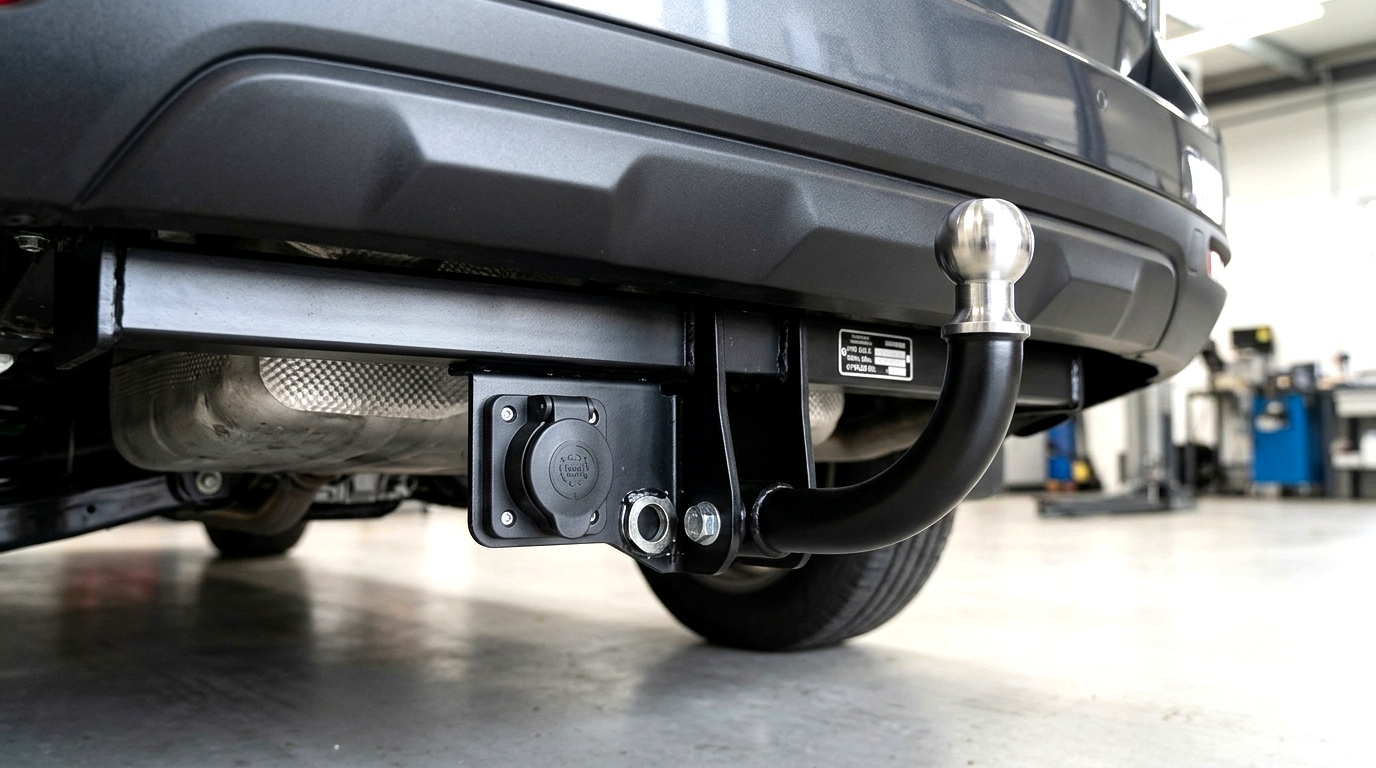
Under EU General Safety Regulation II (Regulation (EU) 2019/2144, Annex II, Item F12), any mechanical coupling device fitted or approved for an M1 vehicle must hold an E-mark type approval pursuant to UN Regulation No. 55 (UN R55).
The Mechanical Strength D-Value
The horizontal structural strength of a mechanical coupling is defined by its characteristic D-value (expressed in kiloNewtons, kN). For passenger cars and light center-axle trailers, the required D-value is calculated according to UN R55 point 2.11:
Where g = 9.81 m/s², T is the Technically Permissible Maximum Laden Mass of the towing vehicle in tonnes, and R is the maximum towable mass of the trailer in tonnes.
For example, for an electric SUV with TPMLM T = 2.6 tonnes and requested towing mass R = 1.8 tonnes:
D = 9.81 · (2.6 · 1.8) / (2.6 + 1.8) = 9.81 · (4.68 / 4.40) = 10.43 kN. The fitted towbar bracket must be certified for D ≥ 10.5 kN.
Geometric Clearances & Ball Height (UN R55 Annex 7, Figure 25)
UN R55 mandates precise spatial dimensions that vehicle body designers must respect:
- Coupling Ball Height: When the vehicle is fully laden to its TPMLM, the center of the coupling ball must sit between 350 mm and 420 mm above the ground surface. (Category M1G off-road vehicles are exempt from the 350 mm lower limit).
- Clearance Zone: A standardized spherical and conical clearance zone (Figure 25) around the towball must remain completely free of obstruction from bumpers, styling trims, tailgates, and parking sensors.
6. Chassis Structural Mounts & Aftermarket Preparation (GSR II Item F12)
A common question from Chinese OEMs is: Does every single vehicle coming off the assembly line need to have a physical towbar bolted on?
The answer under EU law is No. Under Regulation (EU) 2019/2144 (GSR II Item F12) and UN R55 point 5.1, an OEM may homologate an M1 vehicle with a declared towing capacity under "Towbar Prepared / Aftermarket Provision", provided the following conditions are met:
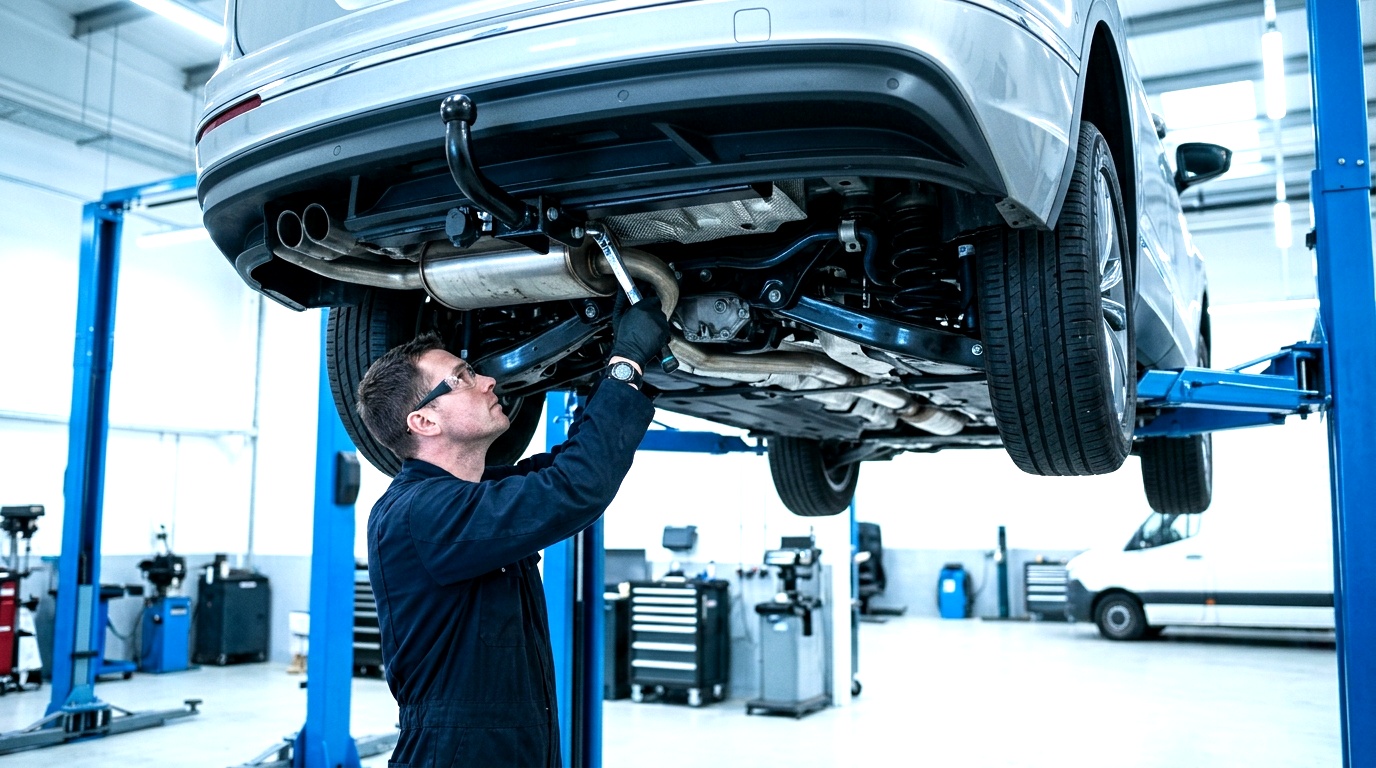
- Statutory Mounting Points: The vehicle chassis body-in-white (BIW) must possess pre-engineered, factory-reinforced mounting holes in the longitudinal side rails to accept an approved UN R55 towbar crossmember without welding or structural cutting.
- Type Approval Drawing (Information Document): The OEM must include in the WVTA Information Document (Regulation (EU) 2020/683 Annex I, entry 2.11.5) detailed engineering drawings specifying the coordinates of the mounting points, maximum permissible overhang, and bolt tightening torques.
- Owner's Manual Instructions: The consumer vehicle handbook must state the approved mounting locations, maximum permissible vertical static load S, and gross combination mass.
7. Braking, Cooling & Dynamic Stability — UN R13-H & UN R140
Certifying towing capacity impacts multiple active safety subsystems:
A. Parking Brake Holding on 18% Incline
Under UN Regulation No. 13-H, the vehicle's mechanical or Electronic Parking Brake (EPB) must hold the fully loaded vehicle combination (towing vehicle at TPMLM + trailer at MMR) stationary on an 18% upward and downward gradient. In battery electric vehicles, software calibrations for the rear caliper electric actuators (MOC) must be validated for this combined holding torque.
B. ESC Trailer Stability Assist (TSA) — UN R140
High-speed trailer oscillation (snaking) is a significant safety hazard. While basic ESC is mandatory under UN R140, advanced European type-approval dossiers incorporate Trailer Stability Assist (TSA) logic. When an ISO 11446 13-pin trailer plug is detected by the Body Control Module (BCM), the vehicle ESC modifies its yaw thresholds and activates selective diagonal braking pulses to damp snaking before uncontrollable jackknifing occurs.
C. Powertrain & Inverter Thermal Dissipation
Towing a box trailer or caravan significantly increases aerodynamic drag (often doubling cruising energy consumption) and thermal loads on the electric traction motor and power electronics. Homologation engineers must verify that continuous towing at highway speeds does not cause inverter overheating or sudden power cutouts.
8. European OEM Benchmark: Handbook Declarations & Industry Precedent
To guide engineering and homologation directors entering the EU, LEBBA Automotive conducted an exhaustive cross-industry benchmark examining how established European and international vehicle manufacturers formulate their official driver handbook declarations, bodybuilder guidelines, and technical service documentation once towing capacities are homologated.
This regulatory research reveals that legacy manufacturers do not merely publish raw figures; they establish precise legal boundaries to protect vehicle warranty, comply with Regulation (EU) 2021/535 Annex XIII, and shield themselves from liability regarding axle overload and aftermarket coupling modifications.
A. Category M1 Passenger Cars & Compact Commercials (N1)
| Manufacturer & Model | Official Published Declaration & Legal Scope | Source Documentation & Technical Basis |
|---|---|---|

Ford
Kuga
|
«No supere el peso máximo autorizado especificado en la placa de identificación del vehículo.»
The European Spanish manual mandates that the vertical static load on the towball must remain strictly within recommended thresholds. (Note: Statements regarding the lesser capacity between vehicle and coupling belong to overseas hybrid manuals, whereas European documentation anchors limits strictly to the statutory VIN plate). |
Official European Owner's Manual • fordservicecontent.com |
SEAT
Ateca
|
«La carga vertical existente hace aumentar el peso sobre el eje trasero y reduce la posible carga útil del vehículo.»
Declares 90 kg vertical load (S) and explicitly informs users that values stamped on the physical towbar plate may exceed the vehicle's authorized capacity, emphasizing that the vehicle's lower threshold prevails. |
Spanish Handbook (Ed. 11/2022) • seat.es |

Tesla
Model Y
|
«Los documentos anteriores tendrán prioridad.»
In case of discrepancies between handbook and technical certificates, the official Certificate of Conformity (CoC), towbar label, and statutory VIN plate maintain absolute legal priority. Spanish spec declares 1,600 kg braked towing capacity and up to 100 kg vertical static load S. |
European Technical Manual • tesla.com |

Volvo
XC60
|
«La carga sobre la bola se cuenta como una parte del peso útil del vehículo.»
Volvo warns that the dead weight of the towbar hardware itself directly reduces the vehicle's available payload capacity. European spec certifies 2,400 kg braked towing capacity and 100 kg vertical load S. |
Volvo Support ES • European Data Sheet |
|
Ford
Tourneo / Transit Custom
|
«Encontrará el peso vertical máximo permitido sobre remolque de su vehículo en el Certificado de conformidad.»
States 100–112 kg vertical load for diesel variants and formally defers to the vehicle's statutory CoC for the exact binding figure. |
Spanish Commercial Fleet Manual • fordservicecontent.com |
|
Ford
Tourneo / Transit Connect
|
«No exceda nunca la masa máxima autorizada del vehículo ni la masa máxima autorizada por eje.»
Expressly accounts for coupling vertical load as part of the vehicle's payload and details its lever effect on rear axle load distribution. |
Fleet Operator Guide • fordservicecontent.com |
Opel
Grandland B
|
«El peso máximo autorizado no debe sobrepasarse.»
Real-world implementation of the 10% rear axle allowance: The Spanish manual authorizes 60 kg additional rear axle load when towing at maximum tractor laden mass, while maintaining the overall TPMLM. Cites 80 kg vertical load and caps vehicle speed at 100 km/h when this axle tolerance is utilized. |
ServiceBox Opel • public-servicebox.opel.com |

Peugeot
308
|
«El cumplimiento de la masa máxima autorizada en la lanza también incluye el uso de accesorios.»
Crucial legal wording: the maximum vertical tongue weight applies equally to towing trailers and mounting accessories (such as towball bicycle carriers). Defers to registration documents and VIN plate for exact MMR. |
ServiceBox Peugeot • public.servicebox.peugeot.com |
B. Category N1G / M1G Heavy Pick-ups & 4x4 Commercials
Heavy-duty pick-ups and off-road vehicles operate at the structural ceiling of 3,500 kg braked towing capacity. LEBBA Automotive analyzed how manufacturers manage combined axle and towbar stress in European documentation:
| Manufacturer & Model | Official Published Text & Technical Scope | Source Document |
|---|---|---|
|
Ford
Ranger
|
«Mantenga el peso del vehículo cargado dentro de su capacidad nominal de diseño, con o sin remolque.»
Requires vehicle total laden weight to remain strictly within design gross combination limits regardless of trailer connection. |
Spanish Driver Handbook (Ed. 08/2025) • fordservicecontent.com |

Volkswagen
Amarok
|
«No exceda la masa total ni la masa remolcable máxima técnicamente admisible indicadas.»
Bodybuilder Directives (Sections 1.14.1 & 1.15.2) enforce strict axle load distribution verification and coupling vertical force checks during commercial conversions. |
VW Bodybuilder Guidelines (Ed. 10/2024) • customized-solution.com |

Toyota
Hilux
|
“The weight borne by the rear axle should not exceed the maximum permissible axle capacity.”
Includes towbar bracket weight and trailer vertical nose load when verifying the towing vehicle's gross laden mass. |
European Owner's Manual OM0K189E, p. 241 • toyota-europe.com |

Isuzu
D-Max MY2024
|
“Tongue load does not exceed the weight limits for the vehicle/tow bar design.”
Declares 3,500 kg braked capacity for European 4WD models and up to 245 kg vertical static nose load. |
European Technical Manual, p. 2-49 • isuzu.co.uk |
Mitsubishi
L200 Series 6
|
“Never exceed the maximum towable weight with brake and the maximum trailer-nose weight as listed in the specifications.”
Publishes separate statutory entries for towable mass, vertical load, gross combination mass, and towbar hardware mass. |
European UK Handbook • isuzu.co.uk / mitsubishi-motors |
Methodological Note: Overseas manuals (such as Thai editions of Nissan Navara D23 or US editions of Jeep Gladiator) were audited during preliminary research but excluded from this benchmark because they reflect non-UNECE regulatory frameworks that do not bind European Type Approval Authorities.
C. Tier-1 Mechanical Coupling Manufacturers (UN R55 Aftermarket)
European towbar manufacturers also issue statutory installation documentation that must legally align with vehicle type approvals:
| Towbar Manufacturer | Component Reference & Vehicle Application | Official Installation Wording & Scope |
|---|---|---|

Enganches Aragón
TowCar
|
Ref. FOR097 (Ranger/Amarok), Ref. ISU010 (D-Max) |
«El MMR (T) puede variar dependiendo del vehículo.»
Mounting documentation marked under UN R55 explicitly reminds fitters that while the towbar steel bracket is rated for high D-values, the vehicle's homologated MMR on the CoC is the supreme legal ceiling. |

Lafuente
Towbars
|
Ref. EE0670 (Ranger) |
«Puede variar según modelo de vehículo.»
Commercial data sheets indicate that both maximum towable mass (MMR) and vertical static load (S) are governed by the vehicle's specific type approval variant. |
GDW
Towbars
|
Ref. 2158 (Hilux), Ref. 2541 (D-Max), Ref. 1813 (L200) |
“The specifications of the towbar must not be exceeded.”
Instructions instruct the installer to verify the vehicle's CoC or registration papers, establishing that neither vehicle limits nor towbar component ratings may be exceeded. |
Key Homologation Takeaways from the LEBBA Benchmark
1. The CoC Hierarchy Rule
As confirmed by Tesla and Ford, the Certificate of Conformity (CoC) and the statutory VIN plate supersede user manual tables. The values in entry 18 must be legally certified before publication.
2. The Payload Deduction Rule
Volvo and SEAT demonstrate that static vertical load S (and towbar hardware mass) directly consumes vehicle payload. Homologation mass budgets must protect passenger seating mass.
3. 10% Axle Tolerance in Practice
Opel Grandland B provides the ideal precedent: +60 kg rear axle tolerance applied solely with a statutory 100 km/h speed limit and compliant tyre load indices.
4. Accessory & Bike Carrier Protection
Peugeot 308 confirms that vertical load S legally governs towball accessories. Declaring S ≥ 75 kg is critical for European customer satisfaction.
5. The Restrictive Ceiling Rule
Towbar component type approvals (UN R55) and vehicle approvals (Reg. 2021/535) operate under a "lowest limit prevails" doctrine, requiring harmonization between Tier-1s and OEMs.
[email protected] and prompt action will be taken.
9. EU Driver Licence Categories (Directive 2006/126/EC)
When defining the Gross Combination Mass (Masa Máxima del Conjunto) and towable mass for European market vehicles, OEMs must strategically align vehicle masses with EU driver licensing thresholds under Directive 2006/126/EC:
| Driving Licence | Statutory Vehicle Combination Limit | Commercial Target & Customer Impact |
|---|---|---|
| Category B (Standard) |
Towing vehicle (TPMLM ≤ 3,500 kg) + light trailer ≤ 750 kg; OR trailer > 750 kg provided Gross Combination Mass ≤ 3,500 kg. |
Mass Market Sweet Spot: 95% of European passenger car drivers hold only Category B. For electric SUVs weighing 2,200 kg TPMLM, a declared towing mass of 1,300 kg allows seamless driving without additional testing. |
| Category B96 Code | Towing vehicle + trailer > 750 kg where Gross Combination Mass is between 3,500 kg and 4,250 kg. | Requires a practical training day or basic skills test (no full theory exam). Popular for horseboxes and mid-size caravans. |
| Category BE | Towing vehicle (TPMLM ≤ 3,500 kg) + trailer up to 3,500 kg (Gross Combination Mass up to 7,000 kg). | Requires a separate formal driving driving test. Used by trade contractors, heavy boat haulers, and commercial horse transport. |
10. LEBBA Automotive Homologation Roadmap & Extension Procedure
For Chinese OEMs seeking to add or increase towing capacity on existing or new European type approvals, LEBBA Automotive delivers turnkey technical service coordination:
- Step 1 — Mass Budget & Axle Calculation: Review of vehicle CAD, curb weight, battery pack mass, and tyre load indices to establish optimal declared MMR (braked and unbraked) and vertical static load S.
- Step 2 — Chassis Structural Validation: Design review of rear longitudinal member mounting points, reinforcement plates, and FEA simulation data under UN R55 dynamic load profiles.
- Step 3 — Physical Test Execution: Coordination with ISO 17025 accredited Technical Services for 12% hill-start witness testing (Reg. 2021/535), 18% parking brake holding (UN R13-H), and 2-million cycle dynamic fatigue testing (UN R55).
- Step 4 — Type Approval Revision / Extension: Drafting the updated Information Document (Annex I to Reg. 2020/683), managing the WVTA Extension package with European Type Approval Authorities, and updating eCoC XML schemas (entries 18.1, 18.2, 18.3, and 18.4).
Need to Certify Towing Capacity for your European Launch?
LEBBA Automotive provides senior homologation engineering, Designated Technical Service testing, and official Authority representation to establish certified European towing capacities.
Contact Homologation Engineering